 AdCrossLab
An English-language guide for overseas companies reaching buyers in mainland China. Understand what must be approved, which placements to consider, how to budget and what happens after the click.
Eligible foreign businesses can apply to advertise in the Weixin ecosystem, commonly described in English as WeChat advertising. Start by confirming your legal entity, business category and permitted destination with Tencent Ads or an authorized service provider. Then choose one business objective, produce Chinese-language creative and test the complete conversion path before buying traffic. An Official Account, an advertising account and an approved ad are separate things.
Entity, category, documents and destination.
Viewing context, format and business objective.
A qualified lead or a confirmed sale.
Scope and evidence. Official sources were reviewed on October 15, 2026. This guide separates official requirements from AdCrossLab recommendations and illustrative calculations. Anonymized practitioner reviews informed the operating advice; they do not establish platform-wide costs or returns.
Can a foreign company advertise on WeChat in China?
Some overseas companies can, but access depends on the registered entity, industry and campaign setup. Do not assume that every foreign brand needs to establish a mainland Chinese company, or that a foreign registration guarantees access to every placement. Ask for an eligibility assessment for the actual product, selling entity and destination before committing to production or agency fees.
Tencent publishes overseas-advertiser review requirements, including category restrictions and a restriction on overseas individuals. This public FAQ has no clear current effective date; use it to identify questions for review, rather than as a complete 2026 approval matrix. Regulated categories and the classification of B2B services require particular care. Obtain the applicable requirements from the platform or your authorized provider for your entity.
WeChat versus Weixin: Tencent describes Weixin and WeChat as separate, interoperable services: Weixin is designed for users in mainland China, while WeChat is designed for users elsewhere. This guide uses the familiar search term “WeChat advertising” for campaigns intended to reach buyers in mainland China. Advertising to Chinese-speaking consumers abroad is a different targeting brief.

For a real audience forecast, use the permitted location, audience and placement settings in the account. Product usage, potential reach, delivered impressions and unique qualified customers are different measures.
How do you open a WeChat advertising account from overseas?
Confirm the onboarding route first, then assemble the documents around that route. The process below is a practical sequence, not a promise of approval or a universal turnaround time. Start through Tencent Ads or a provider verified through Tencent’s official service-provider search.
- Define the advertiser and offer. Record the legal entity, registration country, product category, brand ownership and the market where the product can actually be supplied. Explain the product in clear Chinese, especially when an English category label could be classified differently.
- Confirm access and documents in writing. Request the current entity and industry requirements, authorized account holder, permitted inventory, destinations and any additional review. Do this before assuming that a payment to an intermediary secures advertising access.
- Prepare the documentation. Expect to discuss corporate registration, an authorized representative, brand or reseller authorization where relevant, and industry-specific documents. Tencent’s published qualification framework separates entity, industry, destination and rights-related evidence; the exact overseas checklist must be confirmed for the account.
- Set up the account, billing and permissions. Agree who owns the account and data, who can administer it, the billing currency and payment route, how unused balances are handled, and what an agency can export. Keep platform charges separate from partner service fees.
- Connect the destination and obtain approval. Confirm any Official Account, Mini Program, web destination or customer-contact integration required by the chosen objective. Test the customer journey and event reporting, then submit the creative and destination for review.
Check for inconsistencies: make sure the brand name, legal advertiser, domain owner and product described on the landing page align. Provide a clear explanation and the relevant authorization when different entities are involved. Do not advertise a broader service than the entity or account has permission to promote.
Do you need a WeChat Official Account to run ads?
An Official Account is a content and customer-service asset; it is not the same as an advertising account. Whether you need one, and which assets must be linked, depends on the current onboarding route, objective and ad destination. Have the platform confirm the combination rather than treating “open a WeChat business account” as one complete task.
| Asset or approval | What it does | What it does not prove |
|---|---|---|
| WeChat Official Account | Publishes brand content and provides a persistent presence in the ecosystem. | That an advertising account or any particular ad has been approved. |
| Tencent Ads advertiser account | Provides access to advertiser verification, campaign permissions, billing and reporting. | That all Weixin inventory, formats and destinations are enabled. |
| Mini Program or customer-contact integration | Provides a supported service, transaction or inquiry destination. | That the integration is correctly attributed to the campaign. |
| Creative and destination review | Assesses the submitted advertising materials and customer journey. | Permanent approval of later edits, new offers or different categories. |
Tencent Customer Service’s overseas Service Account registration guide describes registration through the Weixin Official Accounts Platform, selecting the company’s registration country and completing verification. Its overseas route currently supports Service Accounts in supported regions. Follow that guide for the account’s actual region; it is an Official Account registration process, not blanket advertising eligibility.
The official overseas verification checklist includes business-registration evidence, the contact’s identity document, an application letter and operating authorization, plus contact-verification evidence and naming or trademark documents where applicable. Tencent also provides an English enterprise-verification workflow. Keep the verification contact reachable. This checklist concerns Official Account verification; it does not replace advertiser-admission documents.
Which WeChat ad formats should your business use?
Choose the viewing context and conversion objective before choosing an image or video size. A placement is where an ad appears; a format is how the ad is presented; a destination is where the user goes. Keeping these separate makes the media plan and creative brief more precise.
| Placement family | Viewing context | Planning hypothesis | What to verify |
|---|---|---|---|
| Weixin Moments | A social feed, alongside updates from contacts. | Test a clear proposition and credible visual that can earn attention in a brief encounter. | Available image/video template, buying method, call to action and destination. |
| Official Account inventory | Advertising associated with content published by Official Accounts. | Match the offer to a reader’s need for explanation; keep the ad-to-destination promise consistent. | Actual content placement, template and permitted objective. A paid creator article is a different purchase. |
| Mini Program / Mini Game inventory | Service, utility or game sessions. | Assess the specific interaction and audience fit before assuming all Mini Program traffic is comparable. | Inventory and format, interaction requirements, event definition and suitability for the product. |
| Weixin Channels | Video-led browsing and related content experiences. | Test a concise demonstration or a credible presenter with visible product evidence. | Available Channels placement and video template; short-form, livestream and commerce objectives can differ. |
| Weixin Search | An active search task. | Consider query-to-offer relevance when the account has the relevant search product access. | Current access, query or keyword controls, reporting and destination. Do not assume it works like Google Search Ads. |
The placement families above are reflected in Tencent’s official creative and inventory documentation. Availability varies by account and product. Tencent Ads also covers applications outside Weixin, so a campaign described as “Tencent Ads” is not necessarily a WeChat-only campaign.

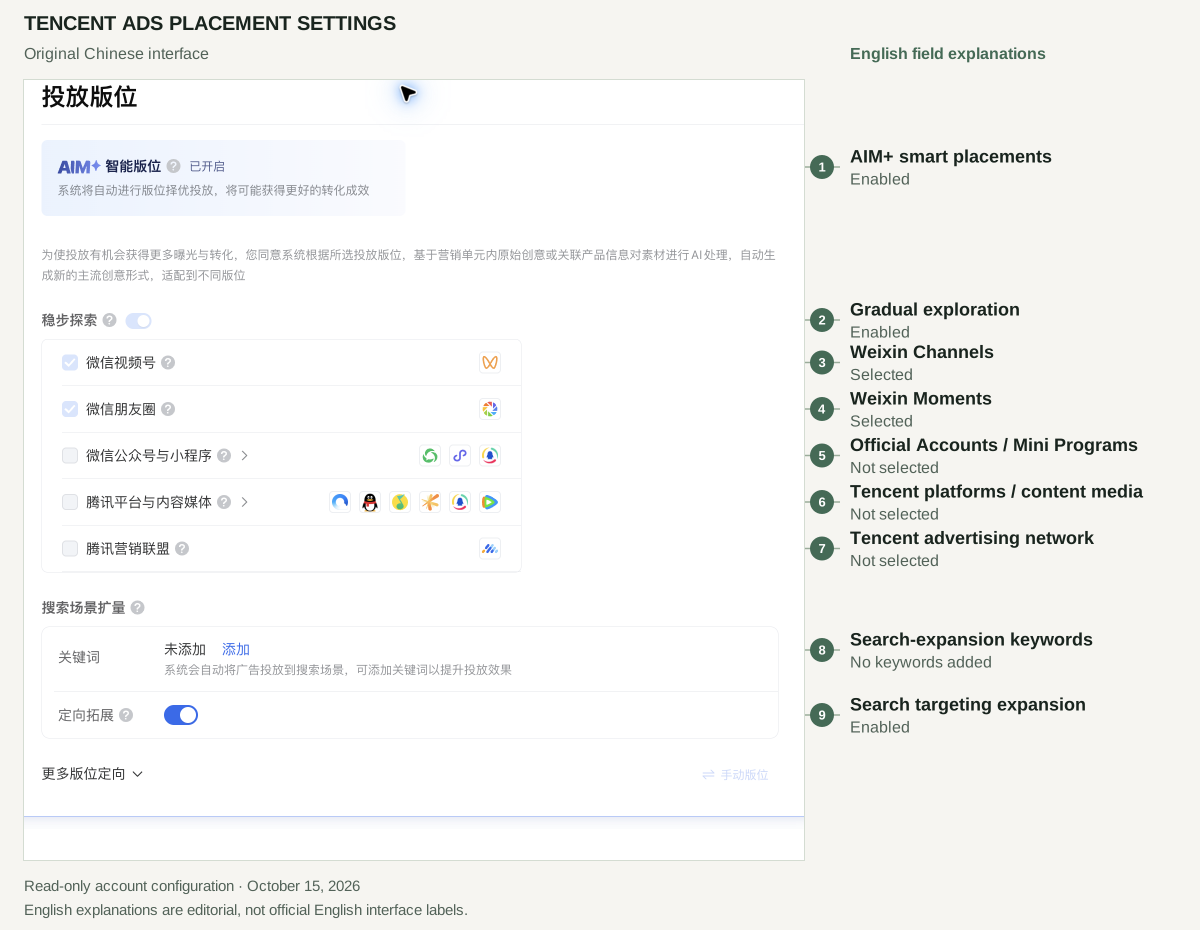
- AIM+ smart placementsEnabled
- Gradual explorationEnabled
- Weixin ChannelsSelected
- Weixin MomentsSelected
- Official Accounts / Mini ProgramsNot selected
- Tencent platforms / content mediaNot selected
- Tencent advertising networkNot selected
- Search-expansion keywordsNo keywords added
- Search targeting expansionEnabled
Figure 3. A lossless high-resolution source capture from one authorized Tencent Ads account on October 15, 2026. The original Chinese interface is retained with matching numbered English explanations beside each field. These explanations are editorial, not quoted official English UI labels. Selected settings do not establish another advertiser’s eligibility, actual delivery or performance.
Channels and Moments are selected. Search keywords are not added, while search targeting expansion is enabled. An empty keyword list does not mean search delivery is disabled; the visible helper text describes automatic delivery in search contexts. Confirm how automation and expansion affect the campaign’s permitted inventory and reporting; this image does not verify the exact search inventory delivered.
For a first test, shortlist the placement that fits the buyer’s task and a destination you can support well. Expanding into every placement at once makes it harder to understand whether the offer, creative or customer journey is responsible for the result.
How much does WeChat advertising cost?
There is no single reliable price for a WeChat campaign. Separate the platform’s applicable funding or buying requirements from the media budget your experiment needs. Costs depend on the placement, audience, objective, competition, season and conversion quality. This guide does not present old public minimum-spend figures as a universal current rate card.
Tencent’s overseas Official Account renewal FAQ states US$99 per verification review, the same fee as first verification. This pays for the third-party review service. It is separate from advertising spend, an agency’s setup fee and campaign management. Confirm the amount shown for your account before paying; the fee does not guarantee approval.
| Budget line | What to ask for | How to evaluate it |
|---|---|---|
| Account and asset setup | Any verification, setup or partner administration charges; payer, renewal terms and official receipt. | Distinguish a platform fee from an agency’s service charge. |
| Media | Required account funding, minimum commitment if any, buying method and account forecast. | Compare the same placement, geography, objective and time period. |
| Creative and localization | Chinese copy, design/video variants, rights, revisions and destination production. | Count usable test variants and adaptation to actual templates. |
| Management and measurement | Agency fee, reporting, event integration, sales handoff and customer-response work. | Agree deliverables and ownership; measure outcomes beyond clicks. |
Understand CPM, CPC and CPA before comparing a quote
CPM is spend per thousand impressions; CPC is spend per click; CPA is spend per defined action. The “action” must be named. A submitted form, a contact addition and a paid order are not interchangeable. Optimization toward a conversion and the underlying billing basis are also separate settings; confirm both for the selected product.
Tencent’s official ad-group documentation distinguishes the optimization goal from the billing event. A target expressed for an online consultation does not, by itself, mean the advertiser is charged only when a consultation occurs.
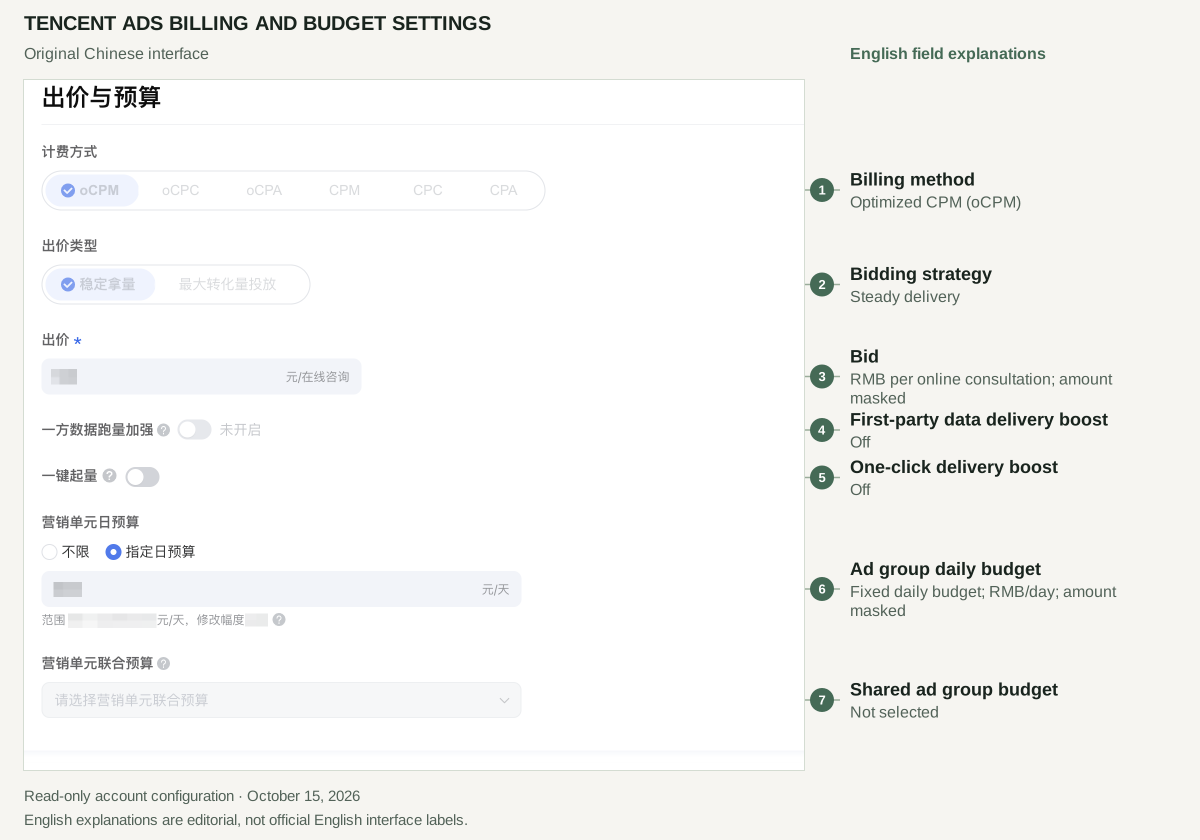
Figure 4. The original lossless source capture from the same account on October 15, 2026, with pixel mosaic restricted to the numerical privacy regions. Every unmasked pixel is unchanged. The original Chinese interface is preserved; numbered English explanations are separate editorial annotations. Visible validation text describes this account’s interface, not a universal spending minimum.
Optimized CPM (oCPM) and the bid’s online-consultation unit are distinct settings. A bid is not a guaranteed achieved CPA or a cost per qualified lead. The masked values are not a rate card, recommended budget or observed performance result.
Work backward from an outcome you can afford
This is hypothetical planning arithmetic, not a WeChat benchmark, forecast or recommended sample size. Forty reported leads at a cost per lead (CPL) of RMB 300 require RMB 12,000 in media spend. If 25% qualify, 10 qualified leads produce a media-only cost per qualified lead (CPQL) of RMB 1,200. Changing qualification changes the economics even when CPL stays constant.

Media budget = planned reported leads × planning CPLCPQL = media spend ÷ deduplicated qualified leads
Set a commercial ceiling using your contribution profit, sales conversion rate and acquisition payback period. Ask a provider to justify a recommended test budget against these inputs, rather than using the platform’s minimum as evidence that the budget can answer your business question.
What makes a good WeChat ad creative?
A useful WeChat ad makes the buyer, problem, evidence and next action easy to understand in the selected placement. Professional presentation helps when it clarifies the offer. It does not require a dense corporate poster. A conversational creative can be credible; a polished creative can still fail to explain what the customer is buying.
Localize the buying situation as well as the words. A mainland Chinese buyer may need to understand delivery, local service, implementation, payment, product compatibility or who handles an inquiry. Replace a literal English slogan with natural Chinese that answers the relevant question, and keep the promise consistent with the actual offer.

- Specify the buyer. For B2B, name the work or business situation so employees, job seekers and purchasers are not treated as equivalent audiences.
- Show the mechanism. Use a real product demonstration, relevant use case or credible evidence. Explain what the product does and what the buyer still needs to do.
- Make one primary promise. Choose a benefit you can support. Give conditions and sources for numerical claims; obtain permissions for people, brands and customer examples.
- Match the next step. A demo request should lead to demo information. A product ad should show the relevant product, availability and purchase conditions.
- Build for the chosen template. Confirm aspect ratio, file requirements, text limits, safe areas and call-to-action rules in the current account. Use Tencent’s official creative-template specification tool; there is no universal image specification for all WeChat ads.
A manageable initial test: compare a problem-focused concept with a product demonstration within a comparable campaign setup. Keep the offer and destination stable where possible. Review downstream inquiry quality before declaring the higher-CTR creative the winner. This is an experimental recommendation, not an official optimal setup.
Where should WeChat ads send people after the click?
Use an approved destination that completes the task promised by the ad. Possible routes include an eligible web destination, Mini Program, content asset or supported lead/contact component. The available combination depends on the ad product and account. A familiar destination is useful only if the buyer can actually load it, understand it and complete the next step.
| Business task | Destination to assess | Before launch |
|---|---|---|
| Evaluate a B2B product | A suitable product explanation or demo page with an approved inquiry route. | Explain use case, implementation and service scope; assign a Chinese-speaking responder. |
| Capture an inquiry | A supported lead form or customer-contact integration. | Test a real submission, routing, follow-up and attribution; capture only necessary information. |
| Buy a consumer product | An approved commerce destination or Mini Program where available. | Check inventory, price, delivery coverage, payment and after-sales support. |
| Research the brand | A relevant Official Account article or other permitted content destination. | Answer the ad’s promise and make the subsequent action understandable. |
Can you use an overseas website? Confirm destination eligibility explicitly. Tencent’s public qualification framework includes domain and filing requirements for certain website routes; it should not be read as approval of every overseas domain, or as a universal instruction that every foreign company must obtain an ICP filing. Confirm the applicable route and test speed and functionality on actual mainland networks inside Weixin.
For any web or customer-contact journey, check the privacy notice, consent where applicable and who receives the information. An advertising approval does not resolve every data-handling obligation. If the required destination cannot be supported, change the plan before purchasing traffic.
How do you track leads and sales from WeChat ads?
Define the business outcome, validate the platform event and reconcile it with your own records. Tencent’s official user-data documentation describes event reporting and conversion data. The current data-source guidance links to DataNexus data-source creation. Use the integration supported for the actual destination; do not assume that a generic website tag or a manual contact addition produces complete attribution.
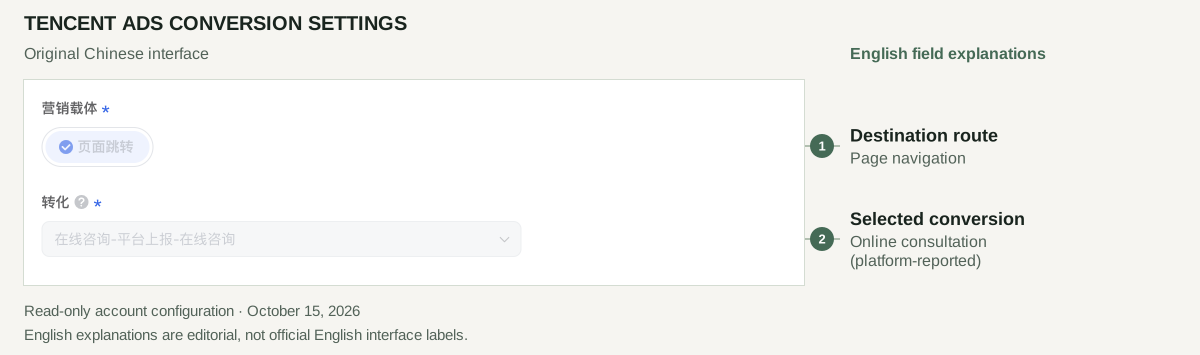
Figure 7. A lossless high-resolution source capture from the same account on October 15, 2026. The original Chinese interface is retained with matching numbered English field explanations. These are editorial interpretations, not quoted official English UI labels or evidence of overseas-account approval.
The selected event is online consultation reported by the platform. It is distinct from a form submission, a CRM-qualified lead and a confirmed sale. Verify implementation, counting unit and attribution in the actual account; this image does not show achieved conversion performance.
| Measurement layer | What it answers | Main limitation |
|---|---|---|
| Delivery: spend, impressions, clicks | Did the campaign deliver and attract attention? | A reported click is not necessarily a completed landing-page visit. |
| Named platform conversion | Did the configured form, contact or purchase event occur? | Depends on event definition, integration, deduplication and attribution settings. |
| CRM-qualified lead or confirmed order | Was the person relevant, reachable and commercially useful, or did a sale complete? | Requires first-party qualification and reconciliation. |
| Opportunity, customer or contribution profit | Did the campaign create business value? | Longer sales cycles, refunds and acquisition costs need mature reporting cohorts. |
Before spending, run a test inquiry or purchase from the ad journey through to the platform report and your CRM or order system. Record the event name, whether it counts events or unique users, attribution window, reporting delay and deduplication rule. Test any handoff into WeCom, Tencent’s business communication service, separately. A manually added contact or a copied QR code may not preserve the intended attribution; confirm the supported implementation.
For B2B, agree a qualification definition such as reachable business contact, relevant company, appropriate role, supported use case and a plausible buying timeline. Calculate CPQL from deduplicated qualified leads and the corresponding campaign spend, using the same attribution and reporting period. For e-commerce, reconcile paid and refunded orders and distinguish revenue-based return on ad spend (ROAS) from contribution profit. Do not add form submitters and conversation starters if the same person can appear in both.
These are English explanations of measurement concepts. Actual Tencent report labels and available events depend on the integration and account; they are not presented here as quoted official English interface names.
How should B2B and consumer brands plan WeChat campaigns?
Use the same discipline, but give each buying journey its own offer, destination and success measure. Platform access and demographic reach alone do not establish commercial fit.
| Decision | B2B business | Consumer brand |
|---|---|---|
| Offer | A defined use case, demonstration or useful consultation. | A relevant product, service or experience with clear availability. |
| Creative proof | Workflow, implementation, customer evidence and responsibility boundaries. | Use case, product evidence, buying conditions and service confidence. |
| Response | Chinese-language qualification and a reliable sales handoff. | Purchase information, stock, delivery and customer service. |
| Primary evaluation | Qualified leads, accepted opportunities and mature customer economics. | Reconciled purchases or bookings, customer acquisition cost and contribution profit. |
The AdCrossLab Tencent-versus-Xiaohongshu B2B case study shows why clicks and reported inquiries cannot establish qualified-customer performance. Its Tencent image-component data is not a verified WeChat-only sample or a forecast of your CPL.
How do you launch your first WeChat advertising campaign?
Launch only after the offer, account, destination, creative and measurement work together. The following is an editorial launch framework. Approval timing and delivery maturity vary, so the stages are more useful than a guaranteed calendar.
| Stage | Work to complete | Decision gate |
|---|---|---|
| 1. Validate access | Confirm entity, category, account ownership, funding and available inventory. | The proposed advertiser and offer have an actionable approval route. |
| 2. Build the customer journey | Prepare the Chinese-language offer, approved destination, response process and event integration. | A real test inquiry or purchase reaches the right system and person. |
| 3. Run a focused test | Use a small number of distinct creative concepts with recorded campaign settings. | Spend and event maturity are sufficient to answer the test question. |
| 4. Diagnose and iterate | Compare delivery, conversion and qualified outcomes; inspect why buyers stop or proceed. | Change a specific weakness before increasing the budget. |
High CTR with weak qualification calls for an audience, promise or destination review. Clicks without valid events call for a journey and tracking check. Good inquiries with no sales may indicate a response, fit, pricing or implementation problem. Do not prescribe a new visual treatment before identifying the failing stage.
A spending threshold alone does not establish statistical confidence. Pause a broken destination or tracking flow immediately. Assess successful delivery only after enough relevant outcomes and follow-up time have accumulated for the decision you need to make.
What should you ask a WeChat advertising agency?
Ask for a plan that makes access, scope, costs and evidence inspectable. A provider’s willingness to explain the setup is more useful than a promise of a universal CPL.
- Which legal entity holds the advertiser account, and who owns the Official Account, destination, creative files and reporting data?
- Which exact Weixin placements will run? Is any wider Tencent or third-party inventory included?
- Which platform charges, deposits, media costs and agency fees are included? What happens to unused funds?
- Which current entity, category and destination rules apply, and what remains conditional on approval?
- What constitutes a conversion, how is it attributed, and how will qualified leads or orders be reconciled?
- Who writes and approves the Chinese copy, substantiates claims and answers inquiries?
- What is the hypothesis, test budget, reporting cadence and decision rule for continuing or stopping?
Use Tencent’s official service-provider search to check the provider’s legal company name, certification scope and validity. Access to an account does not by itself prove authorization to represent Tencent.
Which official WeChat advertising sources should you check?
Use corporate sources for product context, operating documentation for implementation and the current account’s rules for launch decisions. A page being available today does not mean every older price or access condition on it is still universally applicable.
- Tencent 2Q 2026 results — released August 12, 2026; combined Weixin/WeChat MAU as of June 30, 2026. Supports the product-context figure, not an advertising forecast.
- Tencent: Weixin and WeChat — official product definitions and ecosystem context.
- Tencent Ads and its official service-provider search — advertising entry point and provider verification. Confirm current onboarding for your entity.
- Overseas-advertiser review requirements and advertiser qualification framework — public FAQs; no clear current effective date. Used to identify review categories, not to guarantee 2026 access or quote current fees.
- Tencent Customer Service: overseas Service Account registration, English verification workflow and verification documents — account registration and verification, separate from advertising approval. The overseas renewal FAQ supports the US$99-per-review verification fee.
- Tencent Marketing API: creative creation — template-dependent creative elements, inventory and destination parameters. Technical documentation, rather than a universal advertiser rate card.
- Tencent Marketing API: ad-group creation — distinguishes optimization, billing, placement, budget and targeting controls; API field limits are not a universal campaign-budget recommendation.
- Tencent Marketing API: user data and DataNexus: create a data source — event reporting and current data-source implementation references.
Editorial method: AdCrossLab combined official documentation with anonymized practitioner reviews. Internal discussions informed the recommendations on buyer clarity, demonstrations, attribution and qualification. The three Tencent Ads source captures were obtained losslessly at high browser pixel density through read-only access on October 15, 2026. Account identifiers and product information were excluded from the crops. Actual monetary values and the displayed range are locally mosaicked. Every unmasked pixel in the billing screenshot is unchanged from the original lossless capture. Numbered English explanations are added beside the Chinese interface without retyping its controls. No settings were changed or submitted. Private identities and unverified performance anecdotes are excluded.